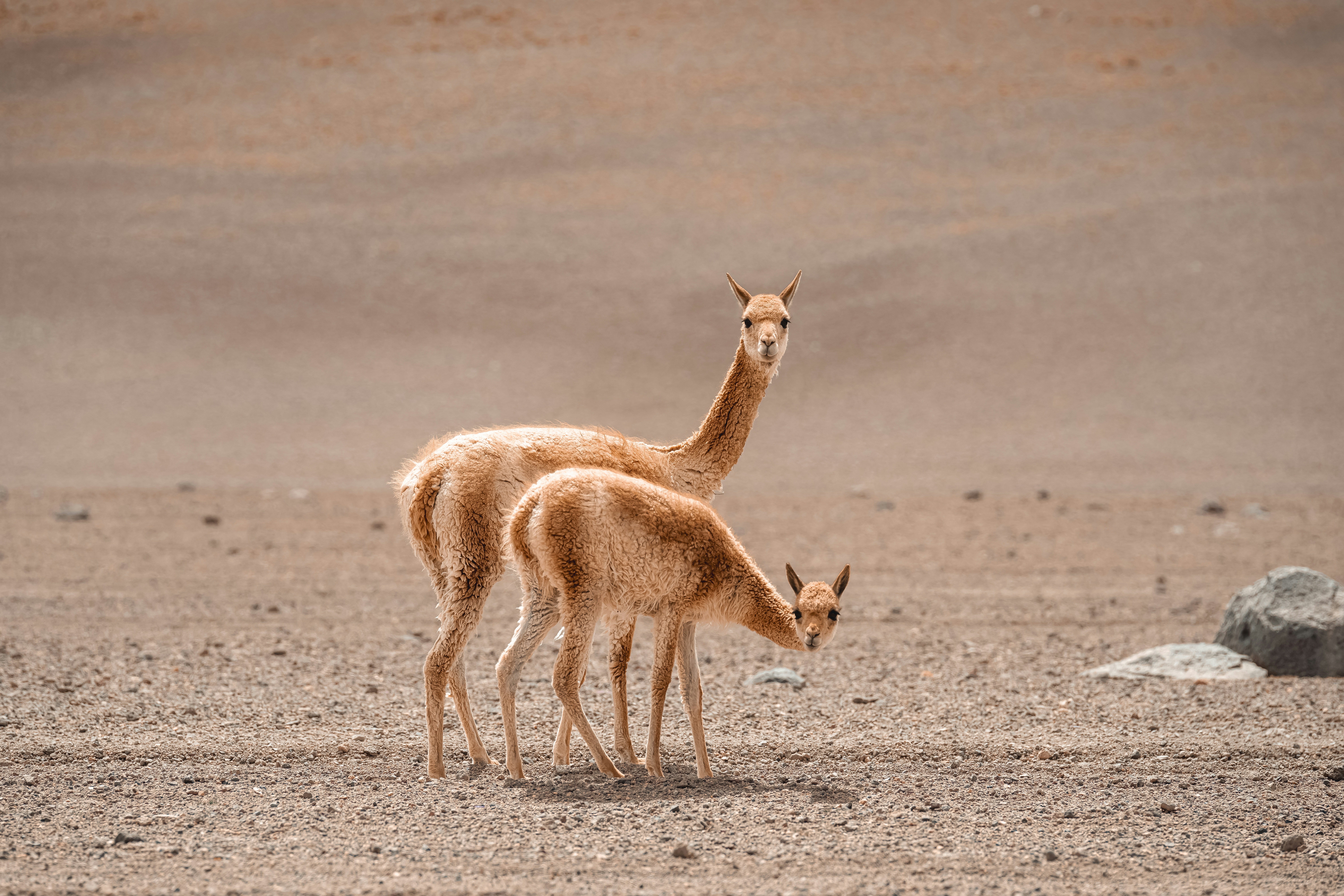
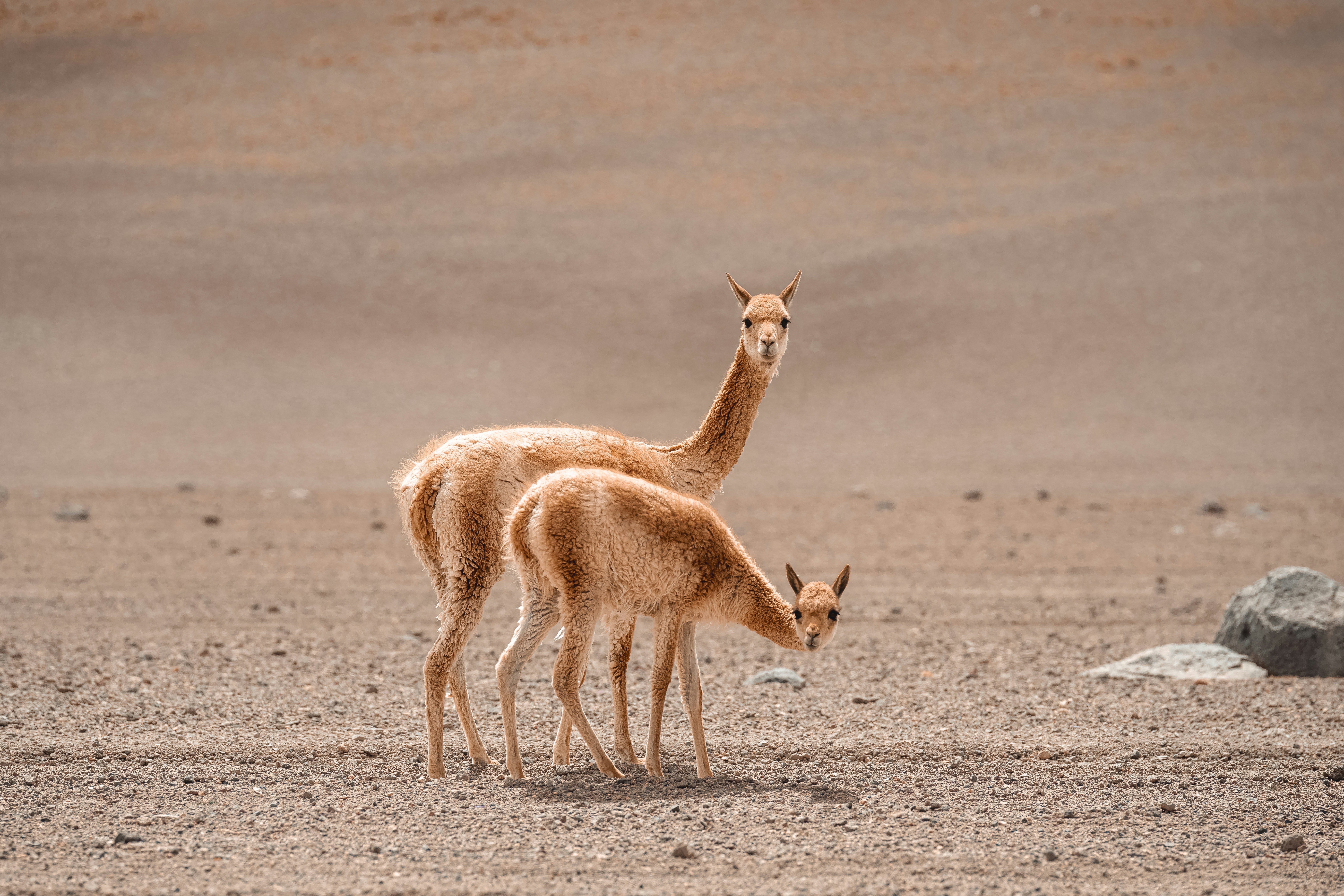
Vicuña
The finest fibre in the world , and the question of who gets paid for it.

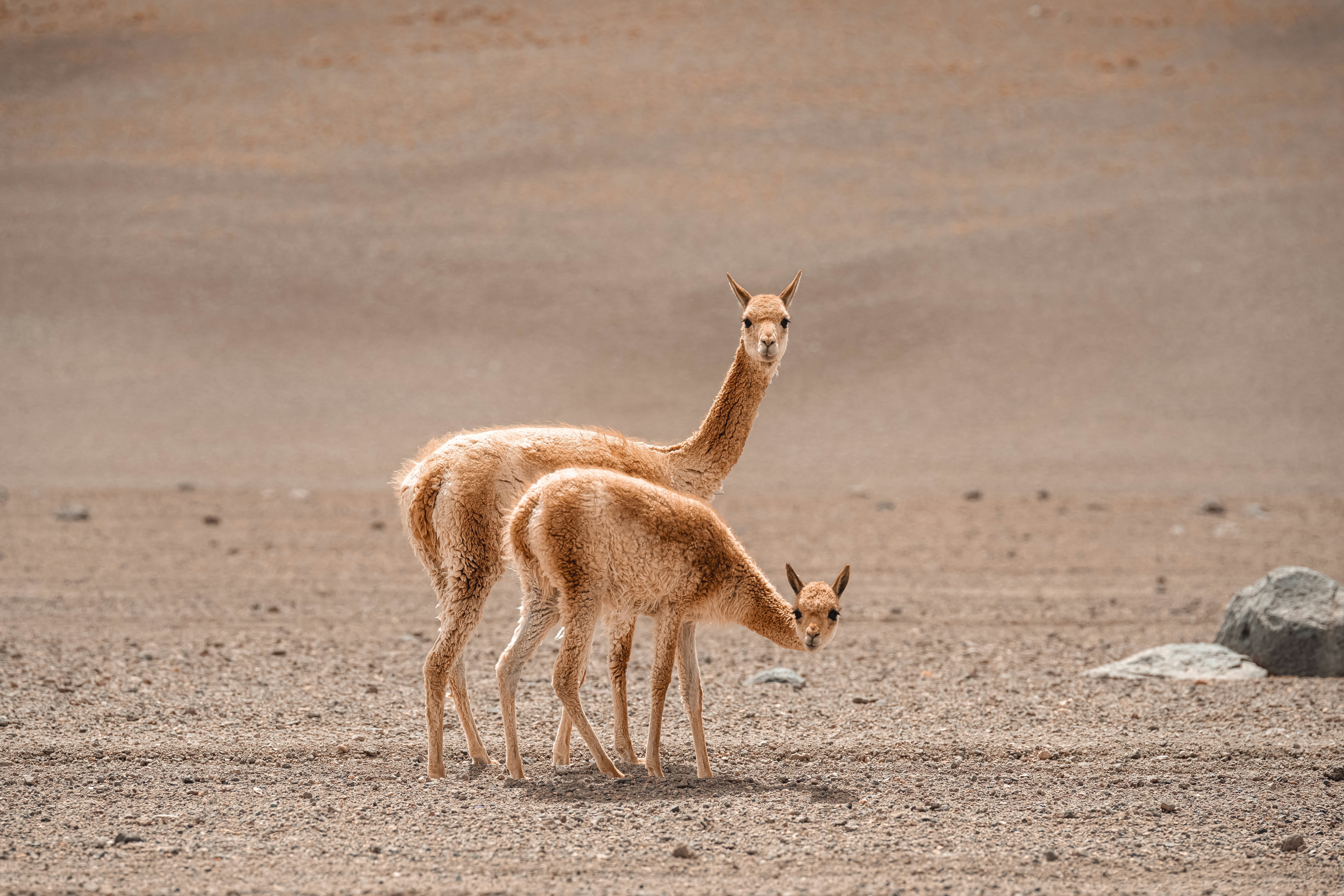
NAME Vicuña. Lama vicugna.
WHERE Wild in the Andes above 4,000 metres. The fibre in question is gathered in Peru, including at Lucanas.
WHAT IT IS Wild camelid fibre, golden brown. Reported at under 13 microns, against 15 for fine cashmere.
HOW IT’S GATHERED The chaccu. Communal herding, shearing, release. An animal can be shorn only every other year.
The vicuña is wild and it lives high. Loro Piana’s own description puts it above four thousand metres. It produces very little and can only be shorn every other year. Bloomberg gives the fibre at under thirteen microns, finer than the best cashmere at around fifteen. It is also short, and short combined with fine is the hardest thing to spin. There is very little for the twist to grip.
The gathering method has a name and it is old. The chaccu is a Quechua word, used by Spanish chroniclers since the sixteenth century to describe how the Inca caught, sheared and released the animals. Bloomberg’s reporting from Lucanas suggests the basics have barely changed. Dozens of people from a village herd wild vicuñas for miles across a plain at thirteen thousand feet, funnel them, hold them, shear them, release them. Each animal’s wool is kept separate. Holding one, by that account, takes skill and nerve, and sometimes a shot of cañazo.
The trade nearly ended altogether. Poachers shot and skinned the animals rather than shearing them, and trade in the wool was outlawed in 1969. An international treaty later reopened a legal market on the condition that income from vicuña benefit Indigenous Andean peoples. According to Bloomberg, Peru then put out feelers for international interest, the prize being a monopoly on the market for the next decade, and Loro Piana won it as the main investor in a three-part conglomerate.
The company tells the next part itself. On its website, Loro Piana says that in 1994, heading that consortium, it signed an agreement with the Peruvian government and the Andean communities granting exclusive rights to buy, process and distribute fibre taken only from animals sheared alive, under CITES rules. Bloomberg reports that the first legal shearing in decades happened at Lucanas that same year, with President Fujimori in attendance, and that Lucanas was the first community to shear under the new regime, with Loro Piana its buyer ever since.
The regulatory picture shifted twice after that. Bloomberg’s account has Peru granting Indigenous communities exclusive rights in 1995 to shear and sell fibre from animals on their territories, which meant companies had to deal with them directly. Then on 24 September 2000, as his government collapsed amid corruption allegations, Fujimori issued a decree giving companies the same rights over vicuñas found on their own property. In 2008 Loro Piana established what it calls the Franco Loro Piana Vicuña Private Property, two thousand hectares in Peru.
Whatever else is true, the conservation worked. Bloomberg puts the current Peruvian population at around two hundred thousand, close to half the world’s.
Then there is the arithmetic, and this is where the reporting gets uncomfortable.
According to Bloomberg’s March 2024 investigation, Lucanas, whose only customer is Loro Piana, receives about two hundred and eighty dollars per kilo of fibre, down from four hundred and twenty in 2012. A sweater made from it sells for about nine thousand. The reporting found that many villagers worked without pay during the shearing and had never seen a finished garment made from their fibre. Lucanas has roughly two thousand seven hundred people. Most houses are mud and have no plumbing. Older residents farm; younger ones leave for cities or for the unregulated gold mines in the region.
Writing to the company a week later, US Congressman Robert Garcia put the fall in price per kilo at a third over just over a decade, and the villages’ overall revenue from vicuña down eighty percent.
The reason the community cannot capture more of the value appears to come back to the fibre itself. Its leaders told Bloomberg they lack the machinery to spin vicuña, precisely because short staple and small diameter make it so difficult. Without that equipment there is no way up the chain. They can gather the rarest fibre in the world and only ever sell it raw.
Loro Piana disputes the characterisation. Its general manager in Peru, Eliphas Coeli, told a government roundtable in April 2024 that the company buys the fibre and deposits payment for its value into an account, and that the distribution of that payment afterwards is beyond its control. The company has said it increased supplier audits and is working with local NGOs on infrastructure, health care, nutrition and education across as many as fifteen communities. Damien Bertrand, then chief executive, told the Financial Times in October 2024 that the company had officially refuted the reporting.
Then a second thing happened, and it was not about Peru.
On 14 July 2025, as reported at the time, a Milan court placed Loro Piana under judicial administration for one year. The court found that the company had negligently facilitated the exploitation of workers at subcontractors, citing what it described as a widespread lack of organisational models and a deficient internal audit system. Production of apparel including jackets had gone to a supplier which in turn used workshops employing Chinese workers in Italy, where the court found undocumented workers were exploited on wages, hours, breaks and holidays. The company itself was not under criminal investigation. The finding was that it had culpably failed to monitor its supply chain. It was the fifth Italian luxury house caught in the same wave.
Loro Piana said it had ended relations with the supplier concerned in under twenty four hours. The administration was lifted early, in April 2026, ahead of its scheduled end that July. Frédéric Arnault, now chief executive, said the steps taken reflected a rigorous and disciplined approach to strengthening governance across the value chain.
Between the two events the company published a centenary book through Assouline, Master of Fibres, celebrating its rare raw materials and its craftsmanship. It did not mention labour practices. In May 2025 it launched Resilient Threads, a five year programme in Mongolia supporting herders and biodiversity.
What seems to connect Peru and Italy is not cruelty. It is distance. In both cases the company’s position was that it did not know: not how the money was divided after it left the account, not who was sewing the jackets four steps down. In both cases that may well be true. Not knowing is what a supply chain is for.
Which brings it back to the label.
The tag in a vicuña sweater gives you the fibre and the country of manufacture. Italy, because that is where it is spun and knitted. It will not say Peru. It will not say Lucanas. It will not tell you the animal was caught by hand at thirteen thousand feet by several dozen people walking a line, that it will not be caught again for two years, or what anyone was paid.
That information exists. It has simply never fit on the tag.
The vicuña reporting throughout is from Bloomberg Businessweek’s investigation of March 2024. Loro Piana’s account of its 1994 agreement and its 2008 property in Peru is from the company’s own website. The Milan court proceedings were reported by Business of Fashion, The Fashion Law and WWD, and the congressional letter is published on Rep. Garcia’s House site.